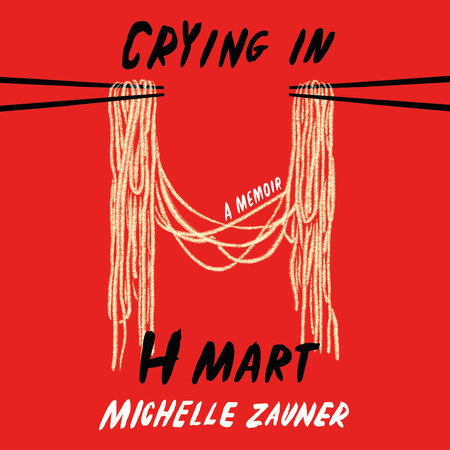
From culinary traditions to cutting tragedy, Michelle Zauner’s Crying in H Mart is a beautiful autobiography of how Zauner—now the primary songwriter of indie pop band Japanese Breakfast—navigated her half-Korean identity from childhood to adulthood, when she lost her mother, a Korean immigrant.
Image Credits
Fig. 1. Na Kim, Crying in H Mart Cover, 2021.
At the beginning, Zauner describes witnessing families enjoying cultural food together—something she did with her mother countless times before her mother passed. These paragraphs were undeniably heartbreaking. Yet paragraphs turned to pages, and pages turned into a chapter…until it struck me that I had zoned out. In other words, Zauner dwelled on this portion a tad too long. A swifter transition to the actual plot would have been better.
Stylistically, Crying in H Mart is sublime. Memories do not appear in chronological order, as in a traditional autobiography. Rather, each unique moment from Zauner’s life comes flooding in streams of consciousness. It felt pristinely human. At the same time, Zauner’s depictions of grief and teenage angst were in no way cheesy, which they can often be in writing. She steers clear from overly elegant and flowery language, able to wrench our hearts and elicit a tear. For lack of a better comparison, Zauner’s prose is high-quality meat without the fat. But of course, there is no rose without a thorn. She presents each memory with the matured, reflective voice of an adult. I desired more variation. For instance, she could narrate childhood stories with more innocence and naivety.
In terms of the Asian American experience, this novel is rich with observations. The author deftly demonstrates what it’s like to be mixed race—to be half in and half out, to always be hiding one part of yourself while flailingly flaunting the other, to never feel whole, to never truly belong. Moreover, Zauner illustrates language barriers when she recounts attempting to piece together the couple words in Korean she knows in order to communicate with relatives and prove her Koreanness. It’s a very real grapple with identity.
Finally, she highlights the cultural differences between Asians and Westerners, something all Asian immigrant families face. Zauner recalls complaining to her mother about how “nice and loving” her Western friend’s mother was. While Zauner’s mother could be called a “tiger mom”—the stereotype of an East Asian parent as someone who prioritizes academic excellence and obedience over pastimes—she only wants the best for her daughter and eventually grows to accept Zauner’s differing aspirations. So the next time you walk into a library or bookstore, check out Crying in H Mart: an appealing meditation on grief, food, family, and the Asian American experience.


Leave a Reply