
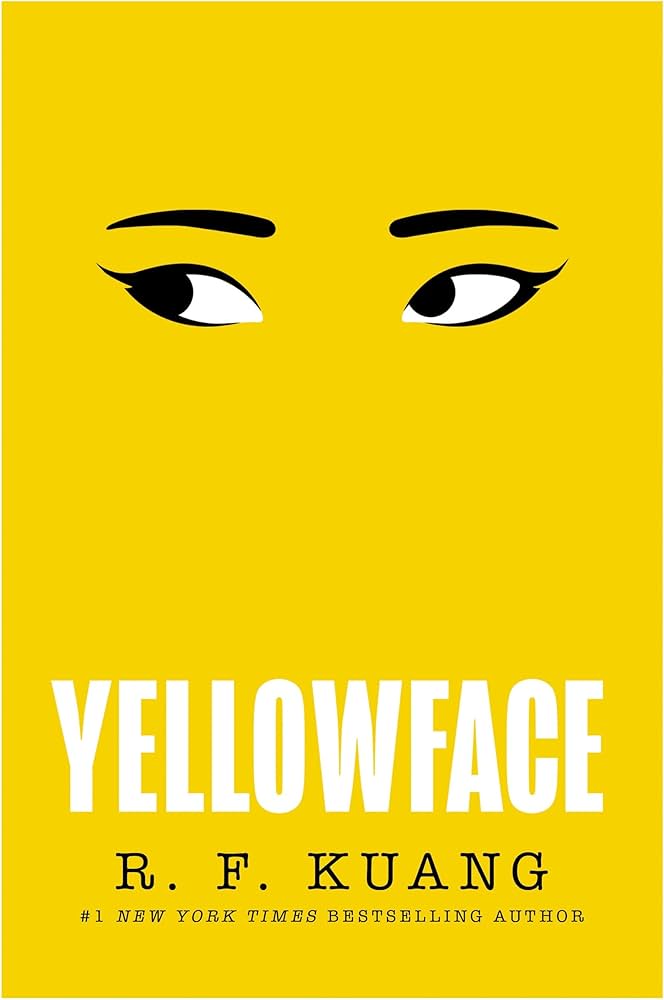
Hear me out. R. F. Kuang deserves the Nobel Prize for Bravery for sending Yellowface out into the world. In this dark, satirical novel about an unsuccessful white author, June Hayward steals friend and literary star Athena Liu’s work following her sudden death. June rebrands herself as Juniper Song to publish her edited version of Athena’s The Last Front, a novel on Chinese laborers during World War I.
Image Credits
Fig. 1. Ellie Game, Yellowface Cover, 2023.
Kuang engages with themes of race, affirmative action, and cultural appropriation—controversies so heated one must applaud her courage. Each riveting word had me contemplating who deserved the success and how.
Kuang’s world-building is stunning, if not alarmingly relevant. From trolling to cyberbullying, she skillfully paints the cruelty of the digital world. At the same time, Kuang critiques the dark underbelly of the publishing industry. She portrays writing as a game of luck, unfair rules, and publishers who hunger after the exotic ethnic stories. She details the subtle drama between writers and editors. She asks the essential question: Don’t all writers steal? After all, are stories not inspired by somewhere or someone? Indeed, Kuang is masterful at stitching nuance upon nuance, embroidering themes that are provocative yet easy to follow.
In addition, June is a thoroughly complex character. She yearns for success after failure upon failure, ultimately resorting to plagiarism to do so—because aren’t we all human? I mentally screamed over her infuriating decisions, yet sighed in pity at the unjust consequences. But Kuang does not receive my A+ in characterization. Oftentimes, June’s persistent cursing, phone addiction, and panting insecurities made me feel like I was reading the ramblings of an angsty teenager rather than a grown, matured woman. However, in terms of Athena, I was relieved to find that she was not simply a picture-perfect celebrity. In fact, her path to stardom was far from moral.
What I admire most about Yellowface is its commitment to ambiguity. It took no sides on race, diversity, or affirmative action. Rather, it provided the reader with a multi-faceted lens through which to ponder themselves. I myself could not choose between June or Athena. The lines between villain and victim were beautifully blurred.
Furthermore, the novel provides engaging insight on the Asian American experience, particularly tokenization. The market latches on to exotic ethnic tales and restricts Asian authors to distinctly Asian stories, just as they did to Athena. The publishing industry profits off of stereotypes. But this novel made me question if Asian authors unintentionally perpetuate stereotypes via their Asian characters—at times unconsciously, or if they are instead protesting stereotypes through stereotypes. One could call Asian authors like Athena “race traitors” for taking advantage of tokenization. Yet what if becoming an exotic brand was their only way to survive as a writer? What if they were not taking advantage of tokenization, but instead succumbed to it under the pressure of publishers?
Moreover, Kuang’s novel prompts us to rethink how we tell Asian stories like The Last Front, and who deserves to tell them. Can a white person tell an Asian story? Hmm? Regardless of the correct answers, I implore you to give Yellowface a chance. Grab it off the shelf, flip to the first page, and lose yourself in one of the most essential novels on Asian American storytelling.


Leave a Reply