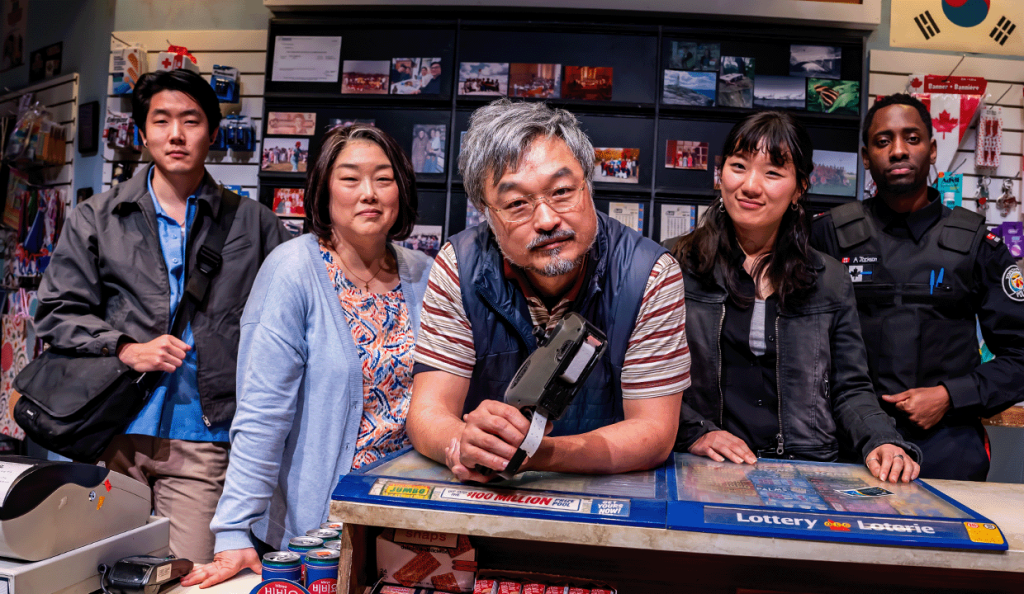
While watching Ins Choi’s play Kim’s Convenience, there was not a single moment I felt like I was sitting in a theater. I did not watch the characters’ lives but rather lived it with them. Kim’s Convenience renders the dynamics between an elderly Korean immigrant, who owns and runs a convenience store in Canada, and his Korean-American children navigating early adulthood. Hilarious, heart-wrenching, and above all, human, Kim’s Convenience is an epitome of the Asian immigrant story.
No one told me watching a play could be a killer abdominal workout. Indeed, Choi saturates this masterpiece with comedy on the Korean accent, culture, and life of the diaspora. However, sugar is delicious, but too much is overpowering. In other words, I loved the jokes but occasionally they embark on tiring tangents that implore me to urge, “Get on with the plot!” Speaking of which, I found the plot somewhat messy: there was not a single idea I could pinpoint as the main idea. Retrospectively, perhaps this was an artistic choice meant to portray the messiness of immigrant life. Emotionally, Kim’s Convenience zips through the entire spectrum. Though overdone, the jokes provide comic relief from devastating family adversity. I was laughing and crying at the same time.
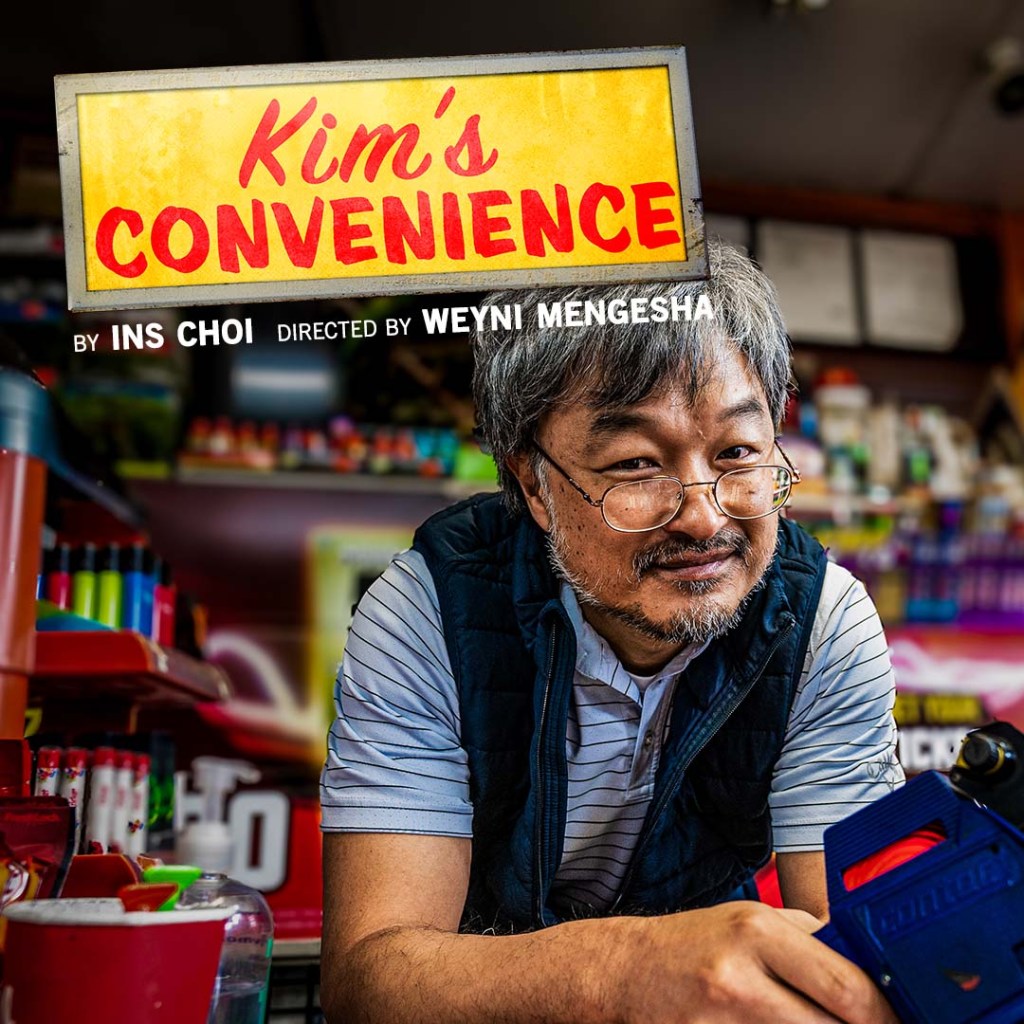
In terms of acting, Ins Choi, who plays Appa (Korea for “father”), this elderly immigrant, is a virtuoso. His Asian accent was simultaneously laugh-out-loud and more than accurate. He is what comedian Stephen He would certify as a “professional Asian dad”, maintaining high expectations of his children, yet loving.
Image Credit
Fig. 1. Dahlia Katz & Aza Jin, Kim’s Convenience Cover, 2011.
On the other hand, Brandon McKnight takes on the role of not one, not two, but a whopping four characters. His versatility blew me away. I thought each of those four characters was a different actor for the full play until the final bow. Conversely, Kelly J. Seo, playing Janet (Appa’s daughter), was alright but could be better. When Janet pauses in reflection or embarrassment, Seo’s articulation makes it seem a tad unnatural and stilted.
This play depicts the dilemma of all immigrants: to hold fast to their home while forging a new one—a better one where their children can become doctors, lawyers, and dreamers. The misunderstanding and racial profiling triggered by Appa’s accent is an experience the AAPI community knows all too well. The comedy highlights this issue well. Additionally, Appa repeatedly mentions the subtle rivalry between Koreans and Japanese because Japan invaded Korea in the past. In fact, Japan also invaded China and thus the Chinese share this minor quarrel. This emphasizes the issue of whether or not AAPI is the best racial categorization because it disregards geopolitical tensions between AAPI nations.
Finally, Kim’s Convenience emphasizes the clash between diaspora and their children. Appa wants Janet to fulfill filial piety by learning to run his family store. Janet yearns for independence after years of assisting her father, even as an adult. Appa wanted Janet to become a doctor or lawyer—to make his hard work worth something. Yet Janet chased her own dream, becoming a photographer instead. In the end, they understand one another. Nevertheless, their strife demonstrates that it is more than just parent vs. child; it is Asian tradition vs. assimilation to Western values.
 Lantern Lit
Leave a comment