
Minor Feelings by Cathy Park Hong is in no way minor. It is more than major. It is the ultimate handbook to Asian American empowerment. It is what every Asian American should read at least once in their life. Hong builds memoir of growing up Korean-American, finding her voice as a writer, and navigating the adult world onto reflection and criticism, constructing a potent monument to Asian America.
In reading this book, I discovered myself. I could finally put a name to how my Asianness made me feel: minor feelings. Hong defines minor feelings as what one feels when America tells you, “You’re Asian! You’re next in line to be white!”, or “Asians are so successful (in STEM-related fields)!”, but you feel like a failure. Because even as the “Model Minority,” the system still finds ways to oppress you, yet silently so that when you express your dissatisfaction—when you allow your minor feelings to become major—you become an aggressive person of color. In fact, before writing this review, I was ready to shun the prose for appearing too aggressive. Yet then I realized that by denouncing Hong’s honesty, I had passively accepted the white supremacy this book seeks to topple.
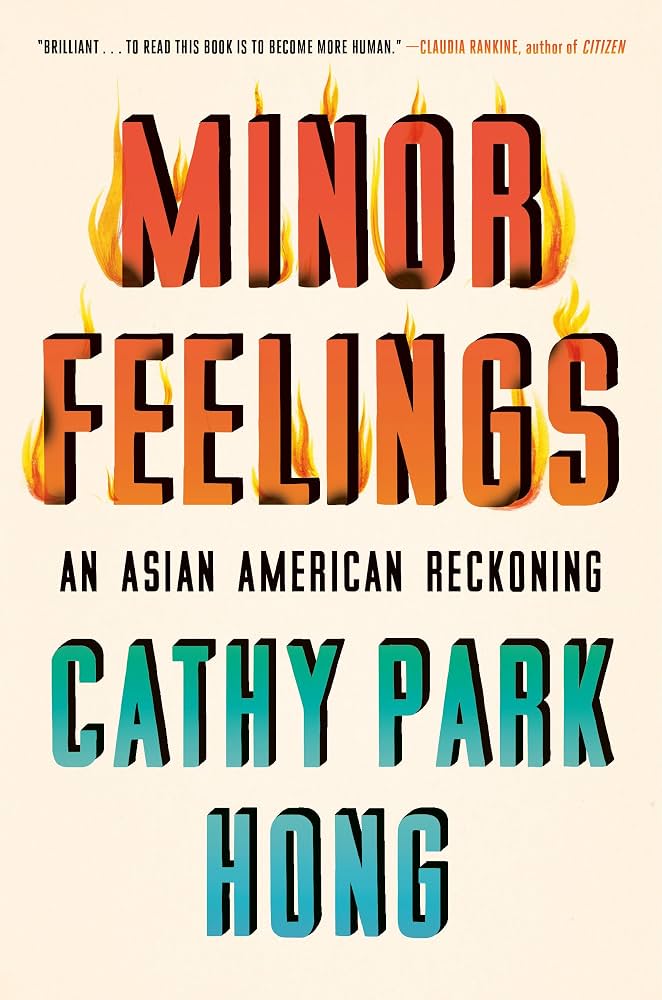
In addition, Hong’s voice is a flaming sword. Her unapologetic truth sears across the pages, her admirable recklessness simmering in the air. The reader can experience her fight against racism as if it were their own. Thankfully, not every page is crammed with fierce emotions. Hong weaves in moments of doubt and paranoia as she searches for identity.
Image Credit
Fig. 1. Na Kim, Minor Feelings Cover, 2020.
My favorite idea that Hong explores—besides minor feelings, of course—is writing as an Asian-American. Hong, an accomplished poet, expresses that her Asian identity feels inevitably and indefinitely tied to her work. She worries that no matter how well she could write, the reader would notice her name—the Asian “tag”—and immediately deem her work unrelatable. Indeed, this is something all Asian writers must face.
On the other hand, I yearn for Hong to make Minor Feelings more accessible to non-Asian readers. At times, her prose feels exclusive towards Asians. Though empowering Asians is necessary, it is equally important to spread these sentiments to others in order to forge allyship and positive race relations. United Asian-Americans alone are not enough to make change. Regardless of this shortcoming, Minor Feelings is a must-read. No exceptions. And if I haven’t convinced you to obtain the book, there’s one more thing I’d like to tell you: I wish it was published as a pocketbook. It is just as essential as a dictionary.


Leave a Reply